4th Grade Reading Project Type of Informarional Text
Informational Text Projects That Build Thinking and Creativity
Ideas for helping you lot move student work from ordinary knowledge to extraordinary thinking

New demands for literacy didactics require an emphasis on both literature and informational text. But pupil piece of work with informational text doesn't have to exist a dry out regurgitation of facts. In fact, putting a artistic spin on student performance tasks can turn informational text projects from ordinary into extraordinary.
You don't have to undertake a massive instructional shift to keep students from rote work and a unproblematic copy and paste. Hither are some ideas for unique and creative projects and products that get students thinking near the content they are reading.
one. Trading Cards
Trading cards are a form of informational text that even young students are familiar with, even if they aren't baseball or Pokémon fans. Creating a classroom ready of trading cards for historical figures, rainforest animals, or fifty-fifty elements on the periodic tabular array, provides a fun manner to learn, and review, information nearly a topic you are studying.
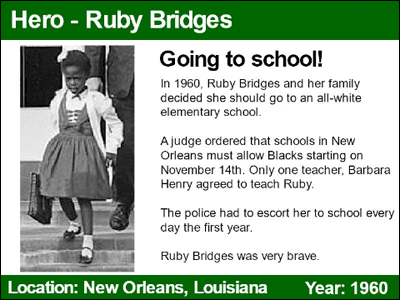
The first time a child gets a pack of trading cards, they may read each ane top to bottom and right to left; but in one case they first a drove, they larn to employ the features of nonfiction texts to apace discover information. Asking them to create their own trading cards, builds their fluency in utilizing headings, labels, and images as they use informational texts in the future.
Considering trading cards are small, students must also carefully choose which information they need to include for their user. Equally they work to summarize, students must evaluate information and determine its importance, improving their comprehension of the topic.
The procedure of creating a trading card, printing information technology out, and sharing it with classmates, too helps students connect the work they are doing in the classroom with their lives outside of it.
2. eBooks
Like trading cards, students are seeing more and more people outside the classroom reading electronic books and may even be using a digital textbook at school. Students are motivated to create and publish their ain eBooks, and see their efforts every bit valuable; especially when the intention is to publish them for an audience exterior of the classroom.
Emerging readers and writers may need to scaffold their enquiry and writing with worksheets that outline what they should include, but older and more than experienced learners may need to be pushed and then that they don't simply copy and paste information direct from their inquiry into their eBooks. You can avert this problem by asking them to create books in ABC, Associative Letter, or even Fact or Fiction style.
ABC Books
The content in an ABC volume is organized around the messages of the Alphabet. For example, an ABC Book on the Desert of the American Southwest might include pages like: A is for Armadillo, B is for Bighorn Sheep, and C is for Coyote. The example below highlights the ocean environment.
Associative Letter
You might also try an associative letter project. In this format, all information is organized effectually a single letter of the alphabet. For case, an associative alphabetic character report on the Revolutionary State of war might contain pages similar: Militia, Massacre, and Midnight Ride.
Fact or Fiction?
In this format, students arts and crafts individual statements nigh their topic followed by the words "fact or fiction?" on a page. Then, they write the answer (fact or fiction) and provide evidence to support their decision.
3. Comics
Creating a comic strip is also a dandy way to become students thinking about the informational texts they are reading. Like trading cards, the express corporeality of infinite in a comic'southward panels requires students to cull the most significant points in a text or story. This summarizing, combined with the extensive use of nonlinguistic representations in comics, improves student comprehension.
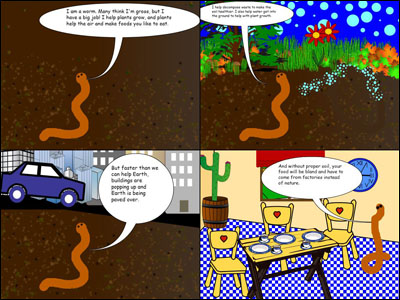
Groovy writing combines all three forms of written advice expressed in the Common Cadre State Standards; narrative, informational, and argument writing. Creating comics based on advisory texts helps students more easily connect this information every bit they develop narratives to share data or arguments to heighten awareness and change beliefs. Sequencing and logic are crucial to good storytelling, and students quickly larn that they can't simply jump forward in time or around in space.
4.Wanted Posters
Creating a Wanted poster for a person, identify, or thing is a highly engaging functioning job that requires students to recall only doesn't require a lot of technical expertise to create.
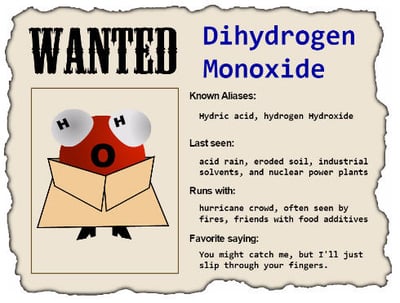
Students can begin Wanted posters with simple identifying physical features and then move further to include information well-nigh qualities that make an object or person unique and connect to its time and place in the earth. For example, asking students to place a "last seen" or "frequently found in" location provide an opportunity for them to demonstrate what features and characteristics look like in action.
5. Infographics
While infographics are popular in the media right now, they are more than just a passing fad. These visual representations of knowledge and information make complex ideas and large amounts of information easy to understand and have quickly become a powerful grade of digital-age advice.
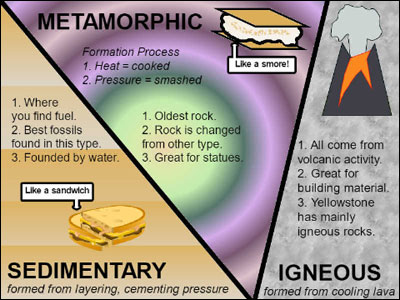
Crafting an infographic to help convey the important information and ideas is a neat fashion to get students thinking more deeply about the information they are reading. To craft an effective infographic, students must identify:
- What is important?
- How can data be organized?
- Is in that location a hierarchy, sequence, or pattern?
- What ideas and information connect to other ideas and information?
Yes, infographics tin exist highly complex if they are based on large amounts of complex data. Merely infographics can also be clear statements of priority and activity, like a Acme Ten listing.
6. Interviews
Science and social studies are filled with big ideas and concepts, non to mention remote fourth dimension periods and locations. To help students make sense of some of these concepts, inquire them to arts and crafts an interview with a connected object. For case, students could interview:
- The hydrogen atom that is part of the h2o molecule
- The Cracking Sphinx of Giza
- The life of a trafficked pangolin
- The plumage in Paul Revere's hat or even Paul Revere himself.
Crafting a fictitious interview can help bring abstruse scientific concepts to life and make history more personal. It also helps students learn how to ask questions. Their formulation of the questions as well helps you better evaluate their comprehension of big ideas behind the facts they find.
Considering they are written in start-person perspective, students must empathize with their subject and can't simply copy and paste information or regurgitate facts. Interviewing helps students identify the perspective of a historian or scientist as they personify the object with gender and other human characteristics.
7. News Broadcast
News broadcasts are much more sophisticated and time consuming but make for a great culminating task in the content classroom. Before an end of the year review, or fifty-fifty exam, ask teams of students to choose a topic you studied and share their knowledge in this engaging format.
Like comics, writing a News Broadcast requires students to employ narrative writing techniques to deliver information. Crafting a News Broadcast helps students think about techniques the media uses to attract viewers and keep them watching, building essential media literacies.
8. Public Service Announcements
Many important issues today, similar climate change and health, tin can aid you connect your students to the content they are learning in science and social studies. Asking students to craft a public service announcement (PSA) to heighten awareness or modify beliefs, lets them know their work and efforts are valuable and can have a existent impact on the world around them.
Scientific discipline, with its connexion to issues that many students are passionate almost, is a great place to ask students to develop public service announcements. Creating a PSA is also a powerful performance tasks for social studies and requires students to exercise skills in all four dimensions of the C3 Framework for Social Studies State Standards.
- Dimension 1. Developing Questions and Planning Inquiries
- Dimension 2. Applying Disciplinary Concepts and Tools
- Dimension 3. Evaluating Sources and Using Evidence
- Dimension iv. Communicating Conclusions and Taking Informed Activity
Developing PSAs provides a great connectedness to skills learned in English Language Arts classes every bit well. Students must research deeply, identify fact versus opinion, develop claims and the testify to back them to write an effective statement.
Getting Started
Choose the production or operation job that you call back will work best in your classroom with your students and which almost effectively provides them with an opportunity to practise reading and writing in real-earth situations, with a existent-world audience. Creative performance tasks like these products not but lets students know their piece of work has value and significant information technology provides an opportunity for students to ask their own questions as they make sense of content and find meaning in the curriculum, not just provide a "correct" answer.

mccutcheonofferel.blogspot.com
Source: https://creativeeducator.tech4learning.com/2018/articles/informational-text-projects-that-build-thinking-and-creativity
0 Response to "4th Grade Reading Project Type of Informarional Text"
Post a Comment