what to look for in a mining pool
There are three master means to participate within a blockchain network. Y'all could be a user, a developer, or a miner.
Users use the network'southward suggestion to fulfill their goals while developers create and maintain their lawmaking. Miners are transaction validators and block creators.
All three roles are co-dependent, and none can exist without the others.
This guide focuses on the miner role and especially what mining pools are conducive for small miners.
Mining has get a competitive exercise, specially within more established blockchains such equally Bitcoin and Ethereum. Information technology is well-nigh incommunicable to mine profitably as a solo miner.
That is where mining pools come in, enabling pocket-size miners to combine their hash charge per unit to earn a chance at creating a cake within a detail network.
By combining computing ability, miners tin participate within any network and earn a reward while contributing to its decentralization regardless of their size.
However, not all pools are conducive for modest miners. Pools operate nether varying policies that could encourage or discourage participation from small miners.
When starting as a small miner with express resources, in that location are some crucial considerations to which you take to pay attention.
We will highlight some of these considerations in the guide and briefly review some of the all-time mining pools for small miners.
These are the pools whose policies work for big and established miners and the pocket-sized players.
How to choose a good mining pool?
Size – the corporeality of hash rate a mining puddle contributes towards a specific network will point the size of the pool.
The college the hash rate, the larger it is. This cistron is essential because larger pools tend to exist more reliable, offering more stable rewards, and charge lower fees.
Fees – as a small miner, y'all demand to be conscious of the amount of fees you pay to your mining puddle, as this will have a more significant bear on on your returns than information technology does on a more prominent miner. The lower the fees, the better.
Payment threshold and frequency – smaller miners tend to earn smaller rewards, and these could take a long fourth dimension to accumulate and become available to withdraw if the mining pool has a high withdrawal threshold.
As a minor miner, you want to get your rewards fast so that yous can reinvest to grow your hash rate.
Location – mining pools provide servers to which miners contribute their computing power. Connecting to the nearest server to you is often advised to maximize your mining potential and speed.
Server location is not merely an important factor to pocket-size miners; information technology is likewise crucial when you are a pocket-size miner trying to maximize your resource to earn maximum returns.
If you lot are located in Australia, read three Best Mining Pools For Australia.
5 All-time Mining pools for small-scale miners
At present that you have an idea of what to wait for when choosing a mining pool, permit's consider some of the best options in the market that will permit y'all to mine leading coins, such as BTC and Ether.
Ethereum miners use GPUs as opposed to ASICs used in Bitcoin, but almost pools back up both networks. (Yous tin can also read our guide on 3 Best Mining Pools For Unmarried GPU.)
If y'all are interested in mining other altcoins, we recommend researching thoroughly to find a mining puddle that works in your situation.
Slush Puddle

Slushpool is the oldest Bitcoin mining puddle today, having launched in November 2010 under the proper noun Bitcoin Pooled Mining Server.
The puddle is currently pushing over 4920 PH/south in hash rate to the Bitcoin network. Since its launch, it has managed to create 35,487 blocks while mining over one,276,466 BTC in rewards.
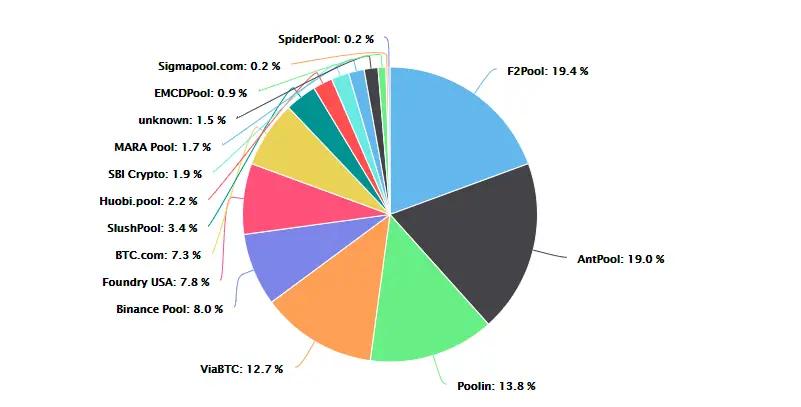
However, Slushpool is not the leading mining pool at the moment. It is not the largest contributing nearly 3.v% of the total hash charge per unit within the Bitcoin network.
The pool supports just mining in two digital currencies: Bitcoin (BTC) and ZCash (ZEC).
In terms of mining pool fees, Slushpool is competitive with other larger pools. It charges a standard two% fee of the rewards from block creation and transaction fees users pay and uses a score-based reward distribution method.
The puddle has a minimum payment threshold of 0.0002 BTC.
Pros
- It is well established equally the oldest running Bitcoin mining pool
- It shares the transaction fees with pool members
- It offers an intuitive user-interface
Cons
- Some other newer platforms offer lower pool fees.
- You could get more stable mining rewards through other pools, contributing more than computing power.
- It supports only two Prisoner of war cryptocurrencies
Poolin

Poolin is amongst the more pop crypto mining pools. Information technology was launched in Oct 2017 and fabricated bachelor to the general public.
Other than Bitcoin, it also supports mining pools for several other altcoins, including Ethereum (ETH), Bitcoin Cash (BCH), Litecoin (LTC), and ZCash (ZEC).
The mining pool currently contributes about xiii.7 EH/due south of computing power to the Bitcoin network, representing approximately 13.8% of the total network hash rate.
Since its launch, Poolin has created 21,190 blocks or virtually 3% of the unabridged Bitcoin blockchain.
Fees on Poolin are competitive depending on which coin yous are mining. On Bitcoin it's two.five% (FPPS), Ethereum – 1% (PPS+), Litecoin – 3% (PPS), etc.
The charge per unit ranges between one and 4%. The minimum threshold also varies from money to money, with Bitcoin and Ethereum being 0.005 BTC and 0.2 ETH, respectively.
Pros
- Information technology supports multiple coins, most of which offering ameliorate returns compared to mining BTC.
- With its considerable network share, its members tend to enjoy more stable and consistent earnings.
- It offers competitive pool fees with some coins such as Ethereum and CKB.
Cons
- Pool mining fees are as high as 4% for some coins supported by Poolin, such as BCH.
- The minimum threshold could exist steep for a small miner. For instance, the minimum threshold for mining Ether on Poolin is 0.2, which, at the electric current ETH cost, is equal to $700.
F2Pool

Currently commanding well-nigh 17% of the Bitcoin mining marketplace share, F2Pool is the largest amongst its peers.
It contributes well-nigh 22 EH/s of computing power towards the Bitcoin network and a combined total of 145 EH/s amongst all its mining pools.
F2Pool supports mining in several altcoins, including Ethereum (ETH), Ethereum Classic (ETC), Bitcoin Cash (BCH), Litecoin (LTC), Monero (XMR), and DeCred (DCR).
The puddle fees charged by F2Pool range from ii% (PPS+) for Ethereum and Dash to 4% (PPS+) for Litecoin.
Depending on the money, the minimum withdrawal threshold could be competitive. For example, to withdraw your Ether rewards, yous need a balance greater than 0.1 ETH, which is half every bit much as that required for Poolin.
Pros
- Steady and dependable rewards due to its large market share
- Competitive minimum withdrawal thresholds and regular daily payments
- Supports more than 40 coins offering members a multitude of options
- It has a long and established history.
Cons
- Puddle fees could be as high as 4% for some coins, a significantly higher charge per unit than other mining pools.
BTC.com

BTC.com mining puddle is part of the BTC.com family of blockchain tools, including the BTC.com wallet and block explorer.
The mining puddle was launched in September 2016 by leading Bitcoin miner manufacturer Bitmain in addition to the Antpool mining puddle.
BTC.com pool was launched as an open-source bitcoin mining puddle to encourage community participation in the mining and governance of the flagship cryptocurrency.
The pool has grown considerably over the years to command about viii.5% of the total Bitcoin mining market share.
The puddle contributes about xiii.8 EH/s of computing power to the network. Since its launch, BTC.com has created 36,121 Bitcoin blocks.
Pool fees vary depending on the network, with BTC, BCH, and BSV pools attracting 4% charges while ETH, LTC, and DCR pools charge ii%.
The withdrawal threshold varies with the coins being mined, but it is competitive compared to other mining pools. For Bitcoin, it'due south 0.005 BTC, paid out as soon as the threshold is reached.
Pros
- Ranks among the larger Bitcoin mining pools with considerable hash rate, making rewards distribution more regular and undecayed.
- BTC.com is relatively older than other mining pools making it more trustworthy.
- Information technology supports several other coins besides Bitcoin
Cons
- The pools fees are higher than competitors
- Depending on which coin you are mining, the minimum threshold can be steep
Binance Pool

As a brand, Binance needs niggling to no introduction within the crypto industry.
It offers the leading cryptocurrency substitution by trading book, a crypto project launch platform, two parallel blockchains, a wallet, and a blockchain educational content platform, among several other products.
The Binance Puddle is one of Binance's more than recent crypto-related products, having launched in April 2020.
The mining pool supports a limited number of Proof of Piece of work (PoW) mining coins, only you can double in as a staker past joining one of the many staking pools information technology supports as well.
In terms of fees, the Binance Pool charges some of the lowest mining pool fees.
The Bitcoin mining puddle charges a two.5% fee nether the FPPS (Full Pay Per Share) settlement method, which is at par with several other pooling services.
Withal, when it comes to Ethereum, it charges only 0.5% under the PPS+ settlement plan.
Pros
- Contributing nearly 8.9% of Bitcoin's full network hash rate, Binance Pool is one of the larger mining pools offering its members a stable and dependable income.
- Binance Pool comes with a trustworthy brand proper noun and an ecosystem of crypto products that are well integrated.
- The Ethereum mining pool charges some of the lowest fees in the market.
- Binance Pool members receive both block generation rewards and transaction fees.
Cons
- It simply supports two PoW coins, i.e., Bitcoin and Ethereum.
- Binance complies with KYC regulations and requires all members to verify their identities.
Are mining pools worth it?
Mining pools have been effectually since 2010, when Slushpool was launched. At this time, Bitcoin miners had discovered that GPU cards were more constructive at mining BTC than CPUs.
From this point onwards, mining became a more than competitive game, with miners looking to deploy always more than powerful and efficient equipment than their peers.
Read Mining With CPU And GPU At The Same Fourth dimension.
Mining pools accept considerable drawbacks, chief among which is the contribution towards the centralization of networks.
However, they as well benefit pool members, giving small miners a chance to earn a steady income from mining, which may not be possible in such a highly competitive industry.
Final thoughts
As a small miner with limited resources, yous want to choose a mining pool that favors your situation.
Lower mining fees, thresholds, and frequent payments are crucial factors to consider only also is the need for a more than dependable pool, something that comes with prominent players.
The pools we accept highlighted in this guide are a great starting point as you lot consider which one to choose.
They all have their advantages and drawbacks. None is meliorate than the other, only 1 may be better for you. We encourage y'all to research and brand a more informed decision.
mccutcheonofferel.blogspot.com
Source: https://coinwut.com/mining-pools-small-miners/
0 Response to "what to look for in a mining pool"
Post a Comment